
The Nasal Tube
If back-in-the-day stories aren’t your thing, this one isn’t for you.

We used to nasal intubate patients on a regular basis — mostly ODs. It’s a simple, effective technique for securing an airway, and once you have the feel for it, it’s quick. It’s also useful in confined spaces, provided the patient doesn’t have a potential skull fracture. Docs tend to frown on an endotracheal tube in the brain.
We were dispatched to an overdose. I had a medic student riding with me and two probies at the station. The CAD secondary said the patient was down on the bathroom floor and didn’t appear to be breathing.
En route I asked the medic student to hand me a 7.5 ET tube through the porthole. I opened it and with my gloved hand rolled it into a coil in my palm.
We arrived at a full-bore party in progress. We asked where the overdose patient was and got a chorus of “I got no idea, man.” We pushed through the crowd and went looking for a bathroom — one thing this job teaches you is how to read a house layout from the outside.
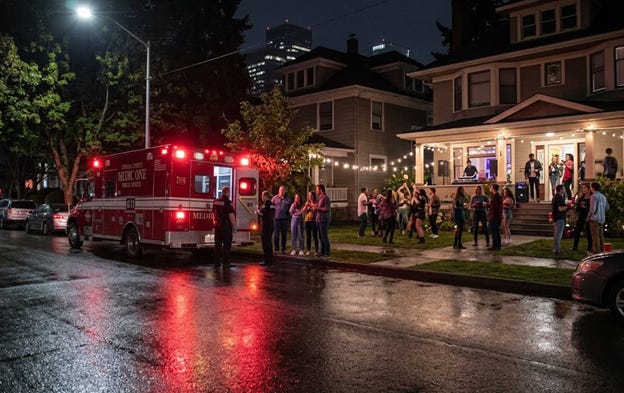
Figure 1 Adobe Firefly
We found him. Very slow, very shallow respirations. He had a pulse.
“Scoop and go. Too many unknowns here and no room.”
The guys picked him up and we asked on the way out if anyone knew his name. Nobody had ever seen him before in their lives.
In the back of the medic unit I handed the medic student the call. He gave the right orders and while he was directing, I opened a packet of lido jelly, lubed the coiled tube, slipped the whistle tip on the end, and slid it into the patient’s nostril.
Everyone went quiet as I advanced it, leaning in to listen for the whistle tip. I heard it, slid the tube in, inflated the cuff, bagged him with the BVM — good chest rise, no noise in the stomach. Tube secured.
I told the medic student to stop gawking and run his call. He did well. Got his IV too.
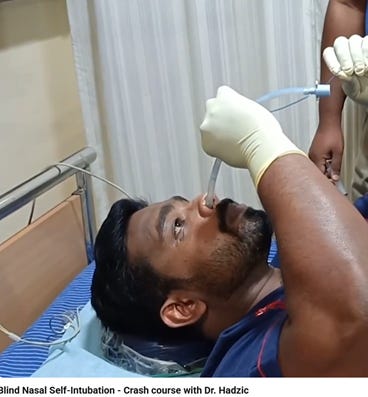
Figure 2 Youtube
He asked for Narcan. In the movies they wake the patient right up. Not on my watch. All that does is create problems you don’t need. You give just enough to improve their respirations so you can bag them. You have no idea what’s in their system or where they are in their high — they can easily crash again. Keep them barely breathing, keep their O2 sats up, and let the ER put them on a drip.
Besides, waking up with a tube in your nose is a reasonable reminder not to OD.
On that note — if Marc was on scene for an OD but not the transporting medic, you never let him near the Narcan. His move was to dump the full 2mg into the patient, then peace out, leaving you alone in the back with a freshly awake, very confused, very angry dope head. He thought this was hilarious. He was not wrong, but only because it was never his problem.
We arrived at the ER and went to our assigned room. The nurse was an old hand I’d known for years. The doc who came in looked about fifteen. First thing out of her mouth, mid-report: “Is that an ET tube in his nose?”
I told her it was and kept going.
She grabbed my arm.
“So that’s an ET tube. In his nose.”
Yes.
“You can do that?”
I pointed to the tube.
She said, “wait right here” and took off at a trot out of the room.
I looked at the nurse. She laughed. Fresh batch of new docs, she said.
The doc came back with someone who looked younger than her — a real-life Doogie Howser, for anyone old enough to remember the TV show about a teenage doctor, which apparently was not far from what we were dealing with. First thing he said: “Is that an ET tube in his nose?”
She said that’s what she’d told him.
I confirmed.
They asked me to step out of the room. I figured I was about to get an airway lecture. Instead, they told me they’d never learned that technique in med school and asked me to show them how it was done.
We went through it several times. They were completely nerded out when we left.
Back at the station we ran a nasal airway class for the crew. The key is to get the tube coiled in your hand before you need it. It’s all about the prep.
Robert, Your voice carries this. Confident, direct, and slightly irreverent in a way that feels earned.
Lines like “Docs tend to frown on an endotracheal tube in the brain” and the Narcan section land with that mix of humor and reality that defines this kind of work.
What stands out most is the quiet authority in the details. You’re teaching without slowing the story down.
It reads like experience passed hand to hand. Love this one, Monica
Wow - just another day, it seems that people benefited from learning your method- surprisingly that know one knew where the passed out person-